




Where to check album ratings, and what those scores actually mean
You're looking at an unfamiliar album in a record shop. The cover has your attention, the price seems reasonable, and a quick search produces three different scores. One site gives it four stars. Another gives it 7.6. A third has an enthusiastic paragraph about how quiet the vinyl is.
Those people may be answering three different questions. Is the music good? Where does it sit in the artist's catalogue? Is this particular pressing worth buying?
A score becomes useful when you know who supplied it and what they were judging. These five services offer different ways into an album. None can tell you whether the chorus will stay with you on the way home.
Five services at a glance
| Service | Who supplies the score? | Scale | What to read it as |
|---|---|---|---|
| Discogs | Community members | 1–5 stars | Votes attached to releases, with averages also shown on master pages; not a dedicated pressing-quality test |
| Pitchfork | Editorial review; separate reader score | 0.0–10.0 | A publication's judgement of the music, distinct from reader opinion |
| AllMusic | Editors; separate user ratings | 1–5 stars | Editorial assessment within the artist's own catalogue |
| Metacritic | Selected critics, aggregated | Metascore out of 100 | A weighted summary of published critical opinion |
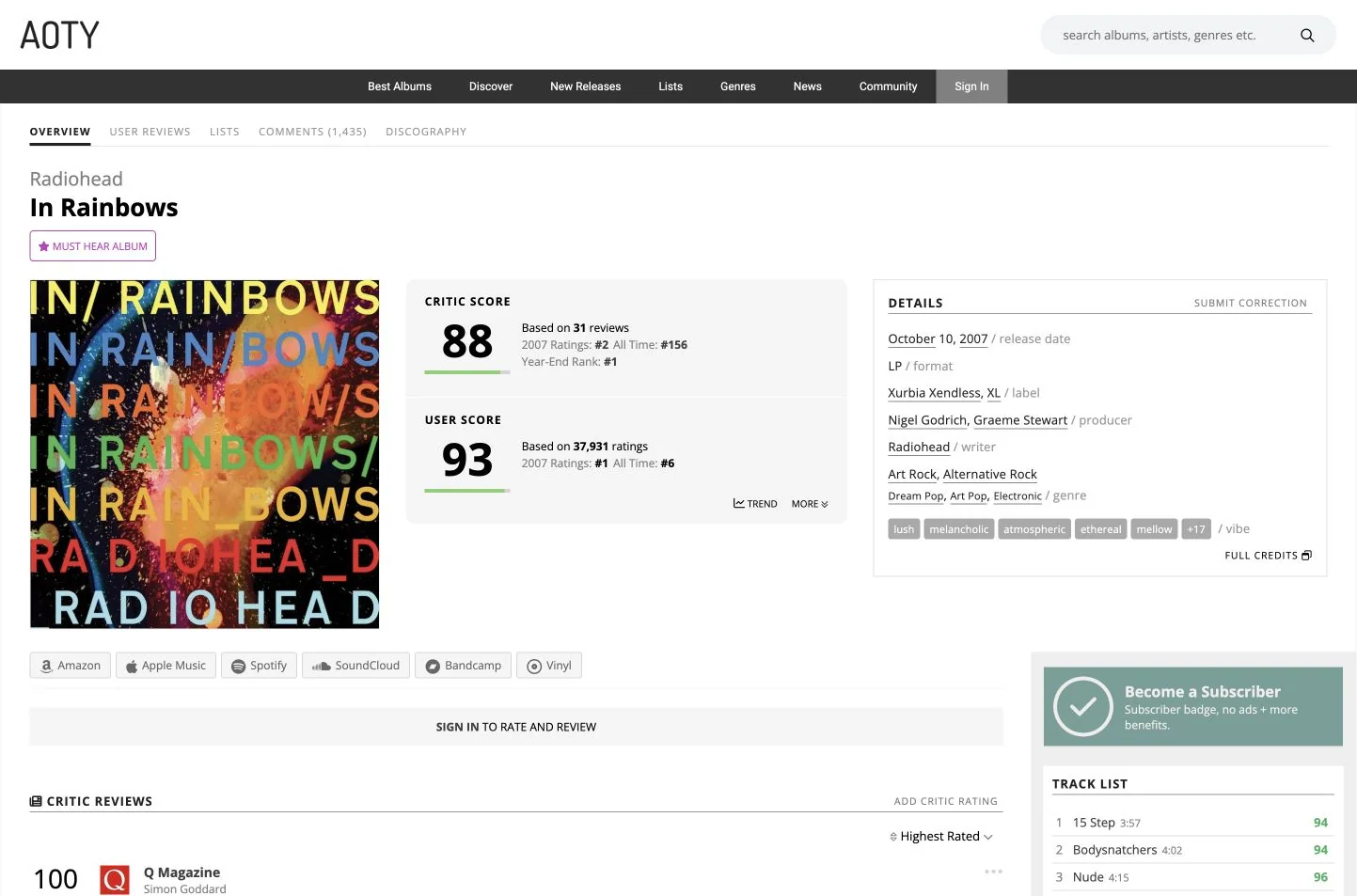
| Album of the Year | Collected critic reviews and site users, kept separate | Scores out of 100 | Two views of reception, with the review and rating counts alongside |
Discogs: the stars need the comments beside them
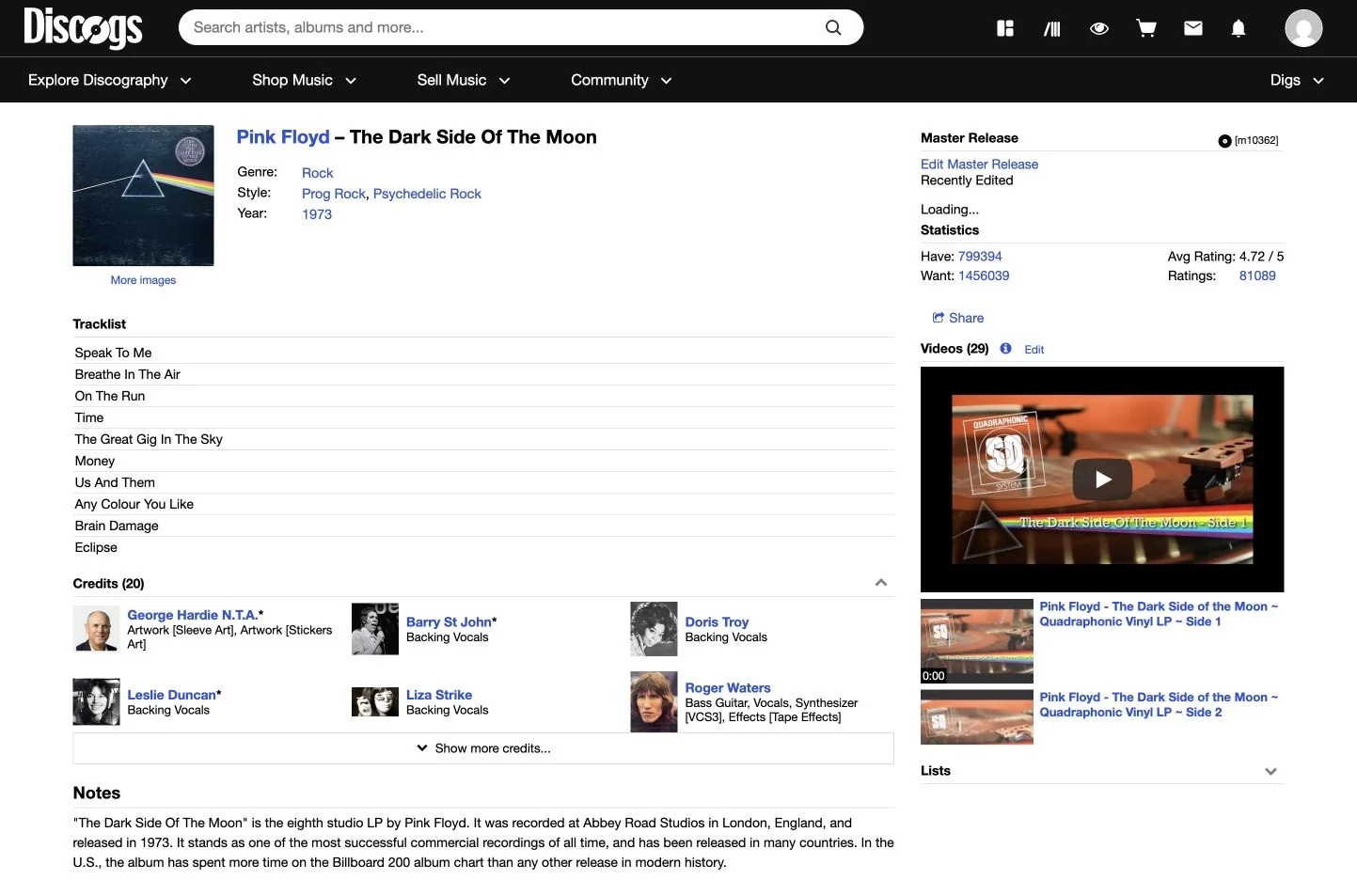
Discogs puts an average and a vote count in its Statistics panel. Individual release pages let members award one to five stars. Master pages also display an average, so check which kind of page you have opened before drawing conclusions about a particular edition.
The control says to rate the release. It doesn't split your vote into songwriting, mastering, surface noise and packaging. The number alone therefore cannot tell you whether voters loved the album, the edition, or both. Treating a high average as proof of a flawless pressing asks the stars to explain something they don't disclose.
For a vinyl purchase, open the exact release and read the written comments. Look for specific observations about noise, warps, missing inserts or a comparison with another identified edition. A comment that names the copy and the problem gives you something to investigate. A bare five-star vote doesn't.
Keep condition separate too. Discogs' media and sleeve grades describe the seller's individual copy. They aren't album reviews. Our pressing identification guide explains how to reach the right release page first.
Pitchfork: a critic's score, with a separate reader score
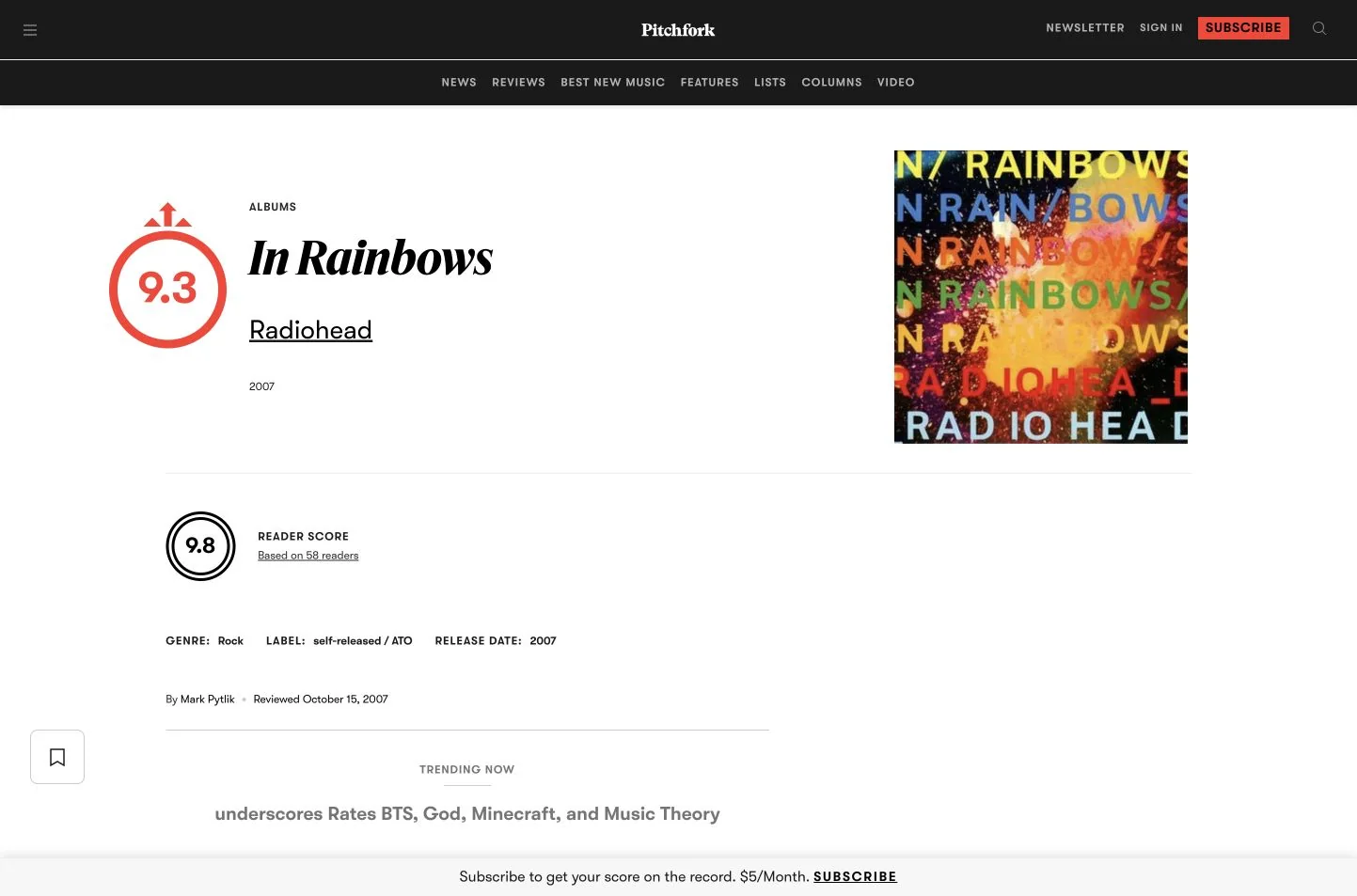
Pitchfork uses a 0.0–10.0 editorial scale. Its scoring guide treats 6.6–6.9 as a good record with some weaknesses, while 8.0–8.5 signals one of the year's stronger releases. A score below eight isn't automatically a warning to stay away.
The In Rainbows review illustrates another distinction: the editorial score and reader score occupy separate positions. Check the label before quoting either.
Then read the argument. Does the writer dislike the very thing you enjoy: repetition, restraint, dense production, a singer who won't quite behave? That disagreement may be a useful recommendation. A decimal point gives an opinion precision on the page; it doesn't make the opinion a measurement.
AllMusic: start within the artist's catalogue
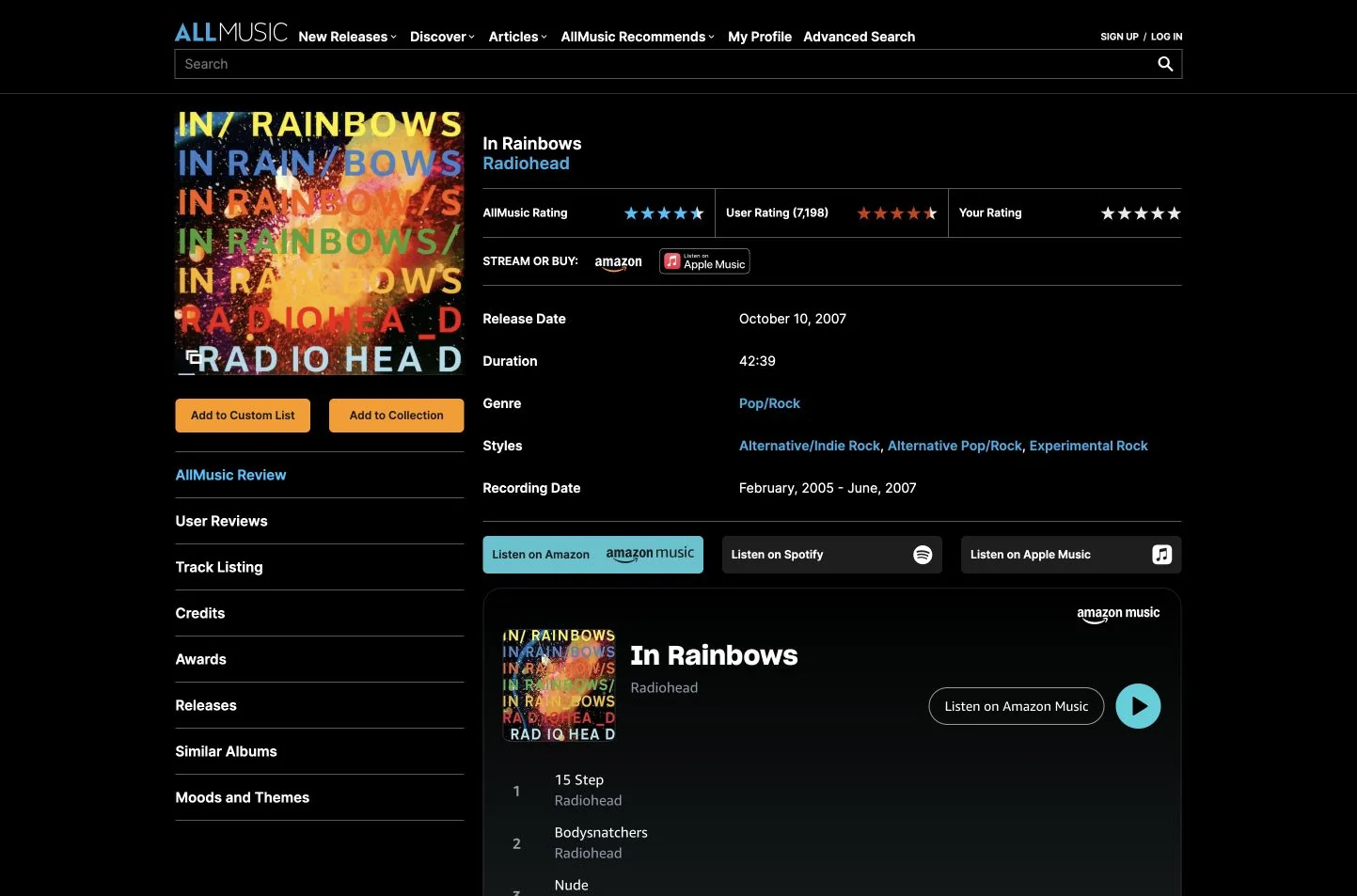
AllMusic's rating explanation makes an unusually useful distinction: editors judge albums within an artist's own body of work. A four-star record by one artist isn't intended as a direct contest with a four-star record by another.
Editors can revisit earlier scores as a catalogue develops. For non-classical music, five stars are generally reserved for records whose importance has lasted; outstanding new classical recordings can receive five stars immediately. A rating can change while the original review text remains.
That makes AllMusic helpful when you already like an artist and want to choose the next album. Read the discography together with the reviews, rather than lifting one number out of it. The separately labelled user rating is the audience's assessment, not an additional editorial award.
Metacritic: a summary of the critics it includes
The Metascore is a weighted aggregate of selected critics' reviews, expressed out of 100. Metacritic explains that process on its methodology page. It represents the critics included in that calculation, rather than every review written about the album.
Use it to get a quick sense of critical reception, then open the contributing reviews. A similar average can conceal either broad agreement or a sharp split. The reasons for that split are usually more interesting than the midpoint.
The music pages can also display a separate user score out of ten. That isn't part of the Metascore. The In Rainbows page currently carries a notice that music user ratings are temporarily disabled, although its existing user score remains visible.
Album of the Year: compare the two audiences
Album of the Year, often shortened to AOTY, places its Critic Score and User Score side by side, each out of 100. The critic section collects published reviews; the user section reflects ratings from the site's community. Both show how many contributions sit behind the number.
This is useful for spotting disagreement and following it back to the writing. Start with the count. A handful of reviews and thousands of listener ratings describe different groups, even when the numbers happen to agree.
Don't confuse the score with a chart position either. AOTY's changelog documents weighted chart sorting that accounts for review counts. Being higher in a chart isn't simply another way of saying an album has a higher displayed average.
Before you buy the record
Choose the question first. For an introduction to the music, read a review and listen to a few tracks. For the next step through an artist's catalogue, compare their albums. For a vinyl edition, identify the pressing and read comments about that edition's manufacture and sound.
Don't turn five services into a homemade grand average. Their audiences, scales and purposes differ, and an aggregator may already include the critic whose score you counted separately. You would be adding apparent certainty without adding another opinion.
Keep the score as a lead. The useful discovery is the record you want to hear again, including the one whose average you can't quite understand.